Air-Cooled Chillers in Modern Manufacturing: When Flexibility Meets Energy Efficiency
View More

 Home News Industry News Smart Plastic Sheet Cooling Systems by AODE: Driving Quality Consistency in Large-Scale Manufacturing
In large-scale plastic manufacturing, consistency is everything. Whether producing thick engineering plates, transparent sheets for thermoforming, or high-gloss decorative panels, temperature stability directly determines surface quality, dimensional accuracy, and mechanical performance. As production speeds increase and tolerances tighten, manufacturers are discovering that a conventional cooling setup is no longer enough. What they need is a smart, integrated plastic cooling system that delivers precise, stable, and traceable thermal control across the entire process.
This is where AODE stands out.
In sheet and plate extrusion lines, molten polymer exits the die at high temperature and must be cooled in a controlled, uniform manner. Uneven or unstable cooling often leads to:
Thickness variation
Warping and internal stress
Surface defects such as orange peel or flow lines
Reduced transparency in clear sheets
Inconsistent mechanical strength
A properly designed plastic sheet cooling system ensures controlled heat removal, synchronized temperature zones, and balanced cooling across rollers, calibration tables, and downstream forming equipment. The objective is not simply to remove heat—but to remove it evenly, predictably, and repeatably.
As sheet thickness increases or material types diversify (PC, PMMA, ABS, PP, PET, etc.), the complexity of thermal control rises dramatically. Manufacturers need more than standalone chillers; they require coordinated system integration.
Founded in Shenzhen in 2004 and later establishing SUZHOU AODE PRECISE EQUIPMENT Co., LTD. in Suzhou in 2007, AODE has focused exclusively on industrial temperature control for over twenty-two years. What began as the production of mold temperature controllers and water chillers has evolved into comprehensive industrial temperature control system integration and high-end precision equipment development.
Today, AODE designs and manufactures advanced solutions for plastic industrial cooling, covering extrusion lines, sheet production, thermoforming, injection molding, and related processes. This long-term specialization enables AODE to approach plastic cooling not as a single machine sale, but as a complete engineering solution.
Large-scale manufacturing presents unique thermal challenges:
As output increases, heat load fluctuations become more significant. If cooling capacity cannot dynamically adapt, sheet thickness variation and stress accumulation follow.
Different rollers and forming sections require independent temperature zones. A uniform cooling strategy is insufficient; intelligent zoning becomes essential.
Engineering plastics often have narrow processing windows. Even minor temperature drift during plastic processing cooling can affect crystallinity, clarity, or impact resistance.
24/7 production requires highly reliable systems with stable pressure, consistent flow rates, and robust safety protection.
Addressing these issues requires not just a plastic plate chiller, but a coordinated system capable of monitoring, adjusting, and optimizing performance in real time.
AODE designs integrated cooling systems based on several key principles:
High-accuracy control algorithms regulate supply and return water temperatures within tight tolerances. Stable temperature directly improves product flatness and dimensional consistency during plastic sheet cooling.
Different rollers, molds, and calibration tables operate in independent circuits. This enables precise plastic molding cooling for upstream forming while maintaining optimized cooling downstream.
Uniform flow distribution across cooling channels prevents hot spots and uneven shrinkage. This is particularly critical in wide sheet production lines where temperature gradients can easily develop across the width.
Instead of oversizing equipment, AODE matches cooling capacity to real production load. Variable frequency drives and adaptive control systems reduce unnecessary energy consumption while maintaining stable plastic production cooling.
Modern cooling systems benefit from digital visibility. Temperature, pressure, and flow parameters are monitored continuously, allowing operators to track performance trends and intervene before quality deviations occur.
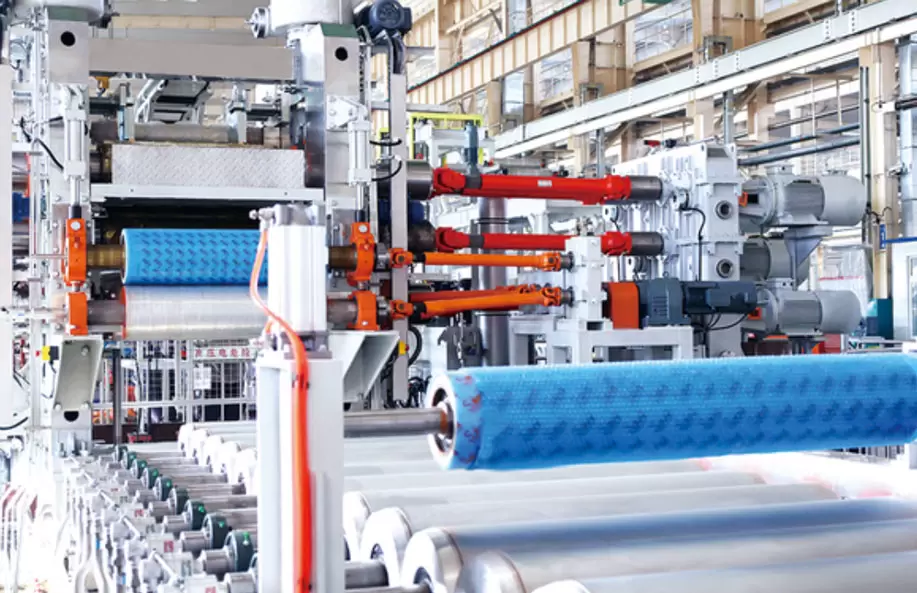
In high-output sheet extrusion lines, cooling rollers are the heart of dimensional control. A well-engineered plastic sheet cooling system ensures:
Uniform roller surface temperature
Stable line speed without thermal fluctuation
Reduced internal stress in thick plates
Improved surface gloss and clarity
For thicker plastic plates, cooling must be gradual and controlled to prevent internal cracking or stress whitening. Here, the design of the plastic plate chiller becomes critical. Proper thermal capacity combined with accurate flow control ensures the cooling curve matches the material's physical behavior.
Many manufacturers still operate with separate chillers, pumps, and control panels, lacking integration. This often results in:
Temperature oscillation
Manual adjustment delays
Poor coordination between process stages
Increased maintenance complexity
AODE addresses these issues through complete system integration. By combining chillers, pumps, heat exchangers, control units, and distribution manifolds into a unified solution, AODE delivers reliable plastic industrial cooling that supports stable production over long operating cycles.
This integrated approach improves not only performance but also maintainability. Centralized monitoring simplifies troubleshooting and reduces downtime.
In competitive manufacturing markets, quality consistency determines brand reputation. Cooling stability directly impacts:
Sheet thickness tolerance
Surface finish uniformity
Transparency stability
Mechanical strength repeatability
Inconsistent plastic processing cooling often leads to batch-to-batch variation. By contrast, a stable cooling platform ensures that each production run meets the same thermal conditions.
For export-oriented manufacturers, consistent quality is essential to meeting international standards and passing customer audits. AODE systems are designed with long-term operational stability in mind, supporting demanding industrial environments.
Modern factories increasingly adopt automation and digital production management. Cooling systems must integrate seamlessly into this environment.
AODE supports communication interfaces that allow temperature control systems to connect with central factory monitoring platforms. This provides:
Real-time thermal data
Alarm notifications
Performance logging
Preventive maintenance scheduling
Such integration elevates plastic production cooling from a background utility to a visible and controllable process parameter.
Over two decades of focus on temperature control have shaped AODE’s engineering philosophy:
Practical design tailored to real production lines
Durable components suitable for industrial conditions
Emphasis on precision and stability
Continuous innovation in control algorithms
From early mold thermostats and water chillers to today’s high-end precision temperature systems, SUZHOU AODE PRECISE EQUIPMENT Co., LTD. has continuously upgraded its technical capabilities.
The company’s experience in plastic molding cooling extends beyond injection molding into extrusion and thermoforming, enabling cross-process optimization.
When selecting a cooling solution, manufacturers should evaluate:
1. Required temperature precision
2. Total thermal load and future expansion capacity
3. Zoning flexibility
4. Energy efficiency
5. Integration with existing production systems
6. Service and technical support availability
A well-designed plastic cooling system is a long-term investment that directly influences product quality and operational efficiency.
In large-scale plastic sheet manufacturing, cooling is not just a supporting function—it is a central determinant of quality consistency. A smart plastic sheet cooling system provides the stability, precision, and control required to meet modern production demands.
With more than twenty-two years of experience in industrial temperature control, AODE has evolved into a comprehensive system integrator capable of delivering advanced solutions for plastic industrial cooling. By combining engineering expertise, system integration capability, and precision control technology, SUZHOU AODE PRECISE EQUIPMENT Co., LTD. supports manufacturers in achieving reliable plastic sheet cooling, optimized plastic processing cooling, and stable plastic production cooling across diverse applications.
For companies aiming to enhance product consistency, reduce defects, and improve long-term operational stability, investing in an intelligent and integrated cooling architecture is no longer optional—it is essential.