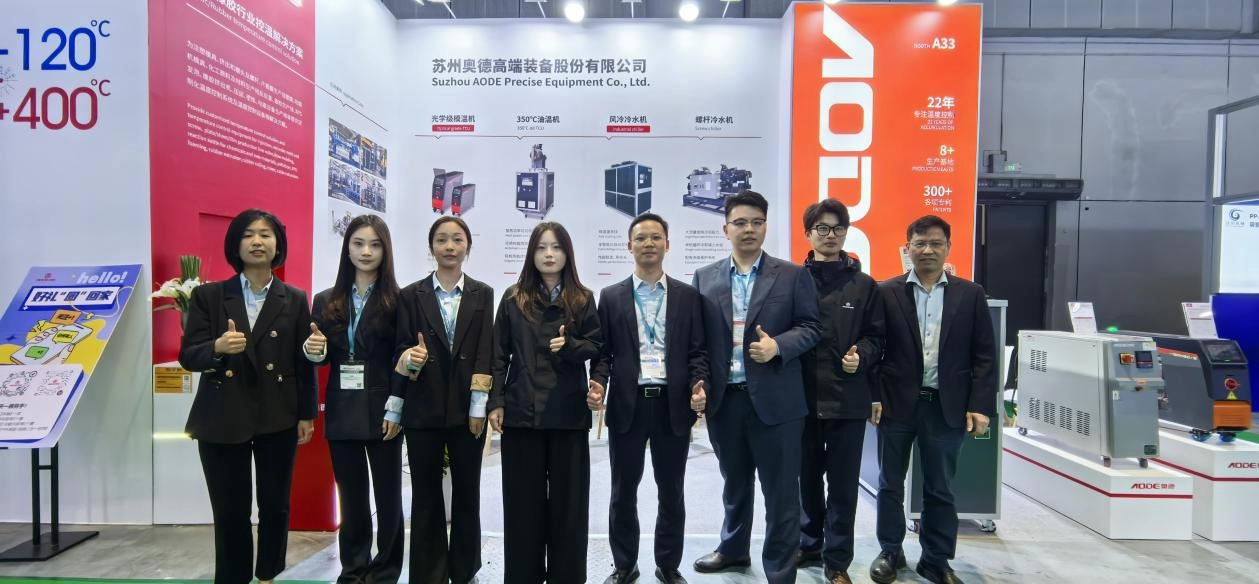
AODE will be hosting you at the 2026 International Rubber & Injection Molding Exhibition, offering precise temperature control throughout the entire process for rubber and injection molding.
View More

 Home News Industry News Next-Gen Film Cooling Equipment: Enhancing Efficiency in Industrial Chiller Units for Printing Film
The global printing film industry is evolving rapidly as manufacturers pursue higher production speeds, tighter dimensional tolerances, better surface quality, and lower energy consumption. Whether producing PET film, BOPP film, CPP film, PVC film, optical films, protective films, or packaging films, maintaining stable process temperatures has become one of the most critical factors influencing production quality and operational efficiency.
Temperature fluctuations during extrusion, calendaring, stretching, coating, laminating, and winding can result in film defects such as thickness inconsistency, shrinkage, warping, bubbles, poor transparency, coating failure, and dimensional instability. To overcome these challenges, manufacturers are increasingly investing in industrial chiller units for printing film that deliver precise cooling performance throughout continuous production.
As an experienced manufacturer in industrial temperature control, AODE (SUZHOU AODE PRECISE EQUIPMENT Co., LTD.) provides advanced cooling technologies designed specifically for demanding manufacturing environments. Through more than two decades of technological development, AODE continues to help film manufacturers improve productivity while reducing operating costs.
Film manufacturing involves multiple heat-generating processes. Plastic pellets are melted at high temperatures before being formed into thin films. During stretching and coating, additional thermal energy is introduced into the production line.
Without efficient cooling, excessive heat may lead to:
· Film thickness variation
· Surface waviness
· Internal stress accumulation
· Curling after winding
· Reduced tensile strength
· Coating adhesion problems
· Increased scrap rates
· Unstable production speed
Even minor temperature deviations can influence the molecular orientation of polymer materials, directly affecting mechanical properties and optical performance.
A properly engineered film thermal system ensures every stage of production operates within an optimized temperature window.
Modern film production lines operate faster than ever before.
Many production facilities now run continuously for 24 hours a day, requiring cooling systems that can maintain stable performance under changing loads.
Traditional cooling systems often experience:
· Slow response to thermal changes
· Large outlet temperature fluctuations
· High energy consumption
· Frequent maintenance
· Reduced cooling efficiency during summer conditions
Next-generation industrial chillers overcome these issues through intelligent control technologies, optimized refrigeration circuits, precision sensors, and energy-efficient compressors.
These improvements translate directly into more stable production and higher product consistency.
Today's advanced cooling equipment is far more than a refrigeration unit.
Modern systems integrate intelligent monitoring, automated regulation, and optimized hydraulic design.
Important features include:
Film production often requires water temperature accuracy within ±0.5°C or better.
Stable coolant temperatures help maintain:
· Uniform film thickness
· Consistent transparency
· Stable coating performance
· Improved dimensional accuracy
Precision temperature control also reduces startup adjustments and minimizes product waste.
Modern chillers use programmable controllers to automatically regulate:
· Cooling capacity
· Water circulation
· Compressor operation
· Alarm systems
· Temperature trends
Operators can monitor the entire cooling process through user-friendly interfaces, reducing manual intervention.
Energy consumption is a major operating expense for film manufacturers.
Advanced chillers utilize:
· High-efficiency compressors
· Electronic expansion valves
· Variable-frequency drives
· Intelligent load matching
· Optimized condenser design
These technologies improve cooling efficiency while lowering electricity consumption.
Cooling performance depends not only on temperature but also on water flow stability.
Proper hydraulic balancing ensures:
· Uniform heat transfer
· Reduced pressure loss
· Improved cooling consistency
· Longer pump life
This becomes especially important for large-scale extrusion lines with multiple cooling zones.
A modern industrial chiller units for printing film solution must support every critical production stage.
These include:
Extruders generate significant heat during polymer melting.
Stable cooling prevents overheating while maintaining optimal melt viscosity.
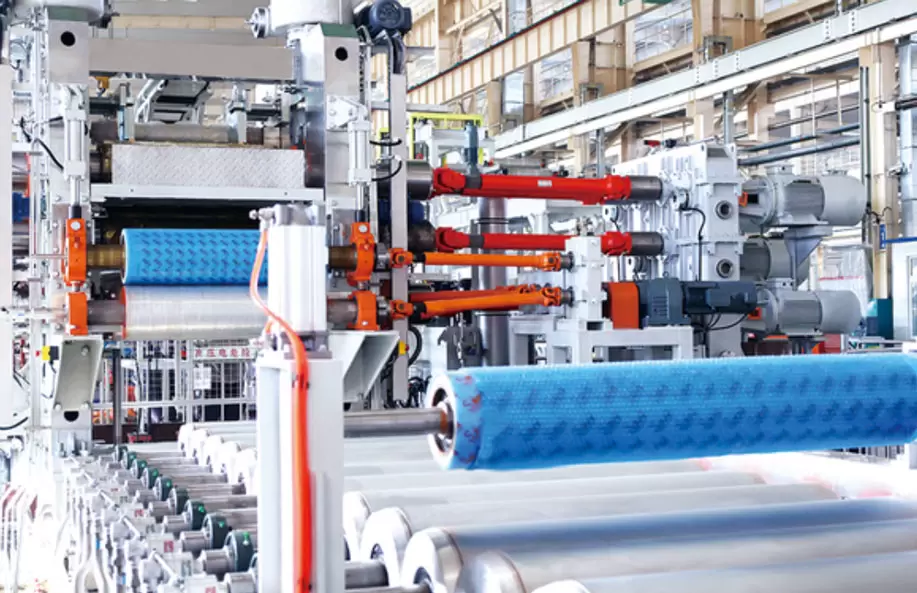
Cooling rollers determine the initial surface quality of the film.
Consistent roll temperature helps produce:
· Better gloss
· Higher transparency
· Uniform thickness
· Reduced surface defects
Biaxially oriented films require accurate temperature control during stretching.
Cooling consistency influences:
· Molecular orientation
· Tensile strength
· Shrinkage characteristics
· Optical clarity
Adhesive coating processes require stable temperatures to ensure uniform coating thickness.
Improper cooling may cause:
· Orange peel defects
· Uneven coating
· Adhesive curing issues
· Delamination
Proper cooling before winding prevents:
· Blocking
· Curling
· Internal stress
· Roll deformation
Every film production line has unique operating conditions.
Different polymer materials have different cooling requirements.
For example:
PET film requires stable crystallization temperatures.
BOPP production demands highly controlled stretching temperatures.
PVC film requires careful heat removal to avoid deformation.
Optical films require extremely tight temperature stability to ensure light transmission performance.
An optimized film thermal system integrates chillers, pumps, pipelines, heat exchangers, sensors, and intelligent controls into one coordinated solution.
Rather than treating cooling as a standalone process, manufacturers increasingly view thermal management as part of the entire production system.
No two production lines are identical.
Factors influencing cooling design include:
· Film width
· Production speed
· Material type
· Extrusion capacity
· Ambient temperature
· Water quality
· Factory layout
This is why many manufacturers prefer customized industrial temperature systems instead of standardized equipment.
Customized solutions may include:
· Multiple independent cooling loops
· High-flow circulation pumps
· Dual refrigeration circuits
· Heat recovery systems
· Remote monitoring
· Centralized cooling stations
· Automatic redundancy
These tailored systems improve overall plant efficiency while simplifying maintenance.
Many manufacturing facilities produce both molded plastic components and industrial films.
In these environments, industrial chillers for precision molding can work alongside film cooling equipment within an integrated temperature control platform.
Shared cooling infrastructure offers several advantages:
· Reduced equipment investment
· Simplified maintenance
· Centralized monitoring
· Higher energy efficiency
· Better factory space utilization
This integrated approach is becoming increasingly popular in automotive, electronics, medical, and packaging industries.
AODE was founded in Shenzhen in 2004 and established Suzhou AODE High-end Equipment Co., Ltd. in Suzhou in 2007. Over twenty-two years of continuous innovation and technical development, the company has grown from manufacturing mold temperature controllers and water chillers into a comprehensive provider of industrial temperature control system integration and high-end precision temperature control equipment.
Today, SUZHOU AODE PRECISE EQUIPMENT Co., LTD. serves customers across numerous industries including plastics processing, printing, packaging, chemical production, electronics, automotive manufacturing, new energy, and precision industrial manufacturing.
AODE emphasizes continuous research and development while integrating design, manufacturing, quality management, and technical support into one complete service system. This allows customers to obtain not only reliable equipment but also application-oriented engineering solutions that address the unique thermal requirements of their production processes.
Manufacturers are increasingly adopting digital production management.
Modern chillers can communicate with factory automation systems through industrial communication protocols, allowing operators to monitor:
· Water temperature
· Pressure
· Flow rate
· Compressor status
· Energy consumption
· Alarm history
· Maintenance schedules
Predictive maintenance helps reduce unexpected downtime and improves equipment reliability.
The result is higher production efficiency and lower lifecycle operating costs.
Environmental regulations continue to encourage manufacturers to improve energy utilization.
Next-generation chillers contribute by:
· Reducing electricity consumption
· Improving heat exchange efficiency
· Lowering refrigerant usage
· Supporting closed-loop water circulation
· Minimizing water waste
· Extending equipment lifespan
For manufacturers pursuing sustainable production, efficient thermal management has become an important component of overall environmental performance.
Choosing the appropriate cooling equipment involves much more than comparing refrigeration capacity.
Manufacturers should evaluate:
· Temperature control accuracy
· Long-term reliability
· Engineering experience
· Customization capability
· Service support
· Spare parts availability
· Expansion flexibility
· Energy efficiency
Working with an experienced industrial temperature control manufacturer reduces project risks and ensures the cooling system matches future production requirements.
As film manufacturing continues toward higher precision, faster production speeds, and greater automation, advanced cooling technology has become an indispensable part of competitive production. Stable temperatures directly influence film quality, production efficiency, equipment reliability, and operating costs.
Next-generation cooling equipment combines intelligent controls, precision refrigeration, optimized hydraulic systems, and energy-efficient operation to meet the demanding requirements of modern film production lines. Whether supporting extrusion, coating, stretching, or winding, an advanced cooling solution provides the thermal stability necessary for consistent product quality.
With more than twenty-two years of experience in industrial temperature control, AODE (SUZHOU AODE PRECISE EQUIPMENT Co., LTD.) continues to deliver reliable, customized temperature control solutions for manufacturers worldwide. From standalone chillers to integrated thermal management systems, AODE helps customers build efficient, stable, and future-ready production environments capable of meeting the growing demands of today's industrial manufacturing landscape.