Air-Cooled Chillers in Modern Manufacturing: When Flexibility Meets Energy Efficiency
View More

 Home News Industry News High Gloss Molding Demands Precision: Inside a Complete High Gloss Mould Temperature Solution
High-gloss molding is one of those processes where small temperature deviations can become visible defects on the finished part. A mould may have the right steel, the right polishing, the right injection parameters and the right material, yet the surface can still show gloss variation, flow marks, weld lines, shrinkage differences or other appearance problems if the mould temperature is not controlled consistently.
For manufacturers producing automotive interior and exterior components, consumer electronics housings, appliance panels, optical parts and other appearance-critical plastic products, mould temperature is therefore more than a supporting process parameter. It is part of the surface-quality strategy.
A high-gloss molding process typically requires the mould to reach a defined temperature quickly, remain stable during production and then cool efficiently when the process calls for it. This creates a demanding thermal cycle. A conventional mould temperature controller may struggle when the application requires both fast temperature response and accurate switching between heating and cooling stages.
This is where a dedicated high gloss mould temperature machine and a properly configured thermal system become important.
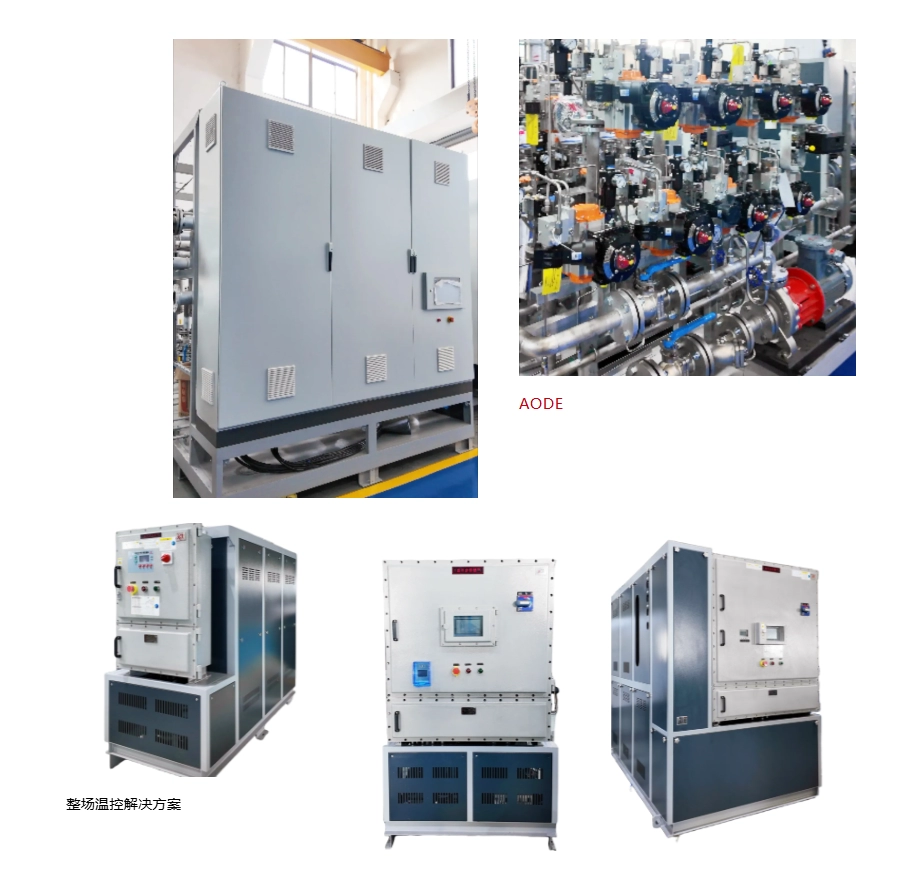
AODE has been working in industrial temperature control for more than two decades. Founded in Shenzhen in 2004, AODE established Suzhou AODE High-end Equipment Co., Ltd. in 2007. After twenty-two years of development, innovation and manufacturing experience, AODE has evolved from its early production of mould thermostats and water chillers into a manufacturer focused on industrial temperature control system integration and high-end precision temperature control equipment.
For high-gloss molding, this experience provides a practical foundation for designing temperature control around the actual moulding process rather than treating the temperature controller as an isolated machine.
In conventional injection molding, mould temperature influences filling, cooling, shrinkage and cycle time. In high-gloss applications, its influence becomes even more obvious because the mould surface is often reproduced very closely by the plastic part.
The temperature of the mould surface affects the way molten plastic contacts and flows across the cavity. If the mould is too cold, the polymer can begin to freeze prematurely. This may restrict flow, make surface imperfections more visible and affect the replication of the mould surface.
If the mould is too hot, cooling time can increase and the production cycle may become longer. Excessive or uneven heat can also contribute to dimensional instability.
The challenge is therefore not simply to increase mould temperature. The objective is to establish a controlled thermal cycle that matches the material, mould structure, part geometry and production requirements.
Several factors make this particularly important:
· Large moulds can contain significant thermal mass.
· Complex cavity designs can create different heat-transfer conditions in different areas.
· Rapid injection generates heat that must be managed during continuous production.
· High-gloss surfaces make minor visual inconsistencies easier to detect.
· Different plastic materials require different processing temperatures.
· Production interruptions can change the thermal condition of the mould.
· Fast transitions between heating and cooling may be required to maintain the intended cycle.
A temperature controller designed around these conditions can provide much better process stability than a basic heating-only system.
A practical high gloss mould temperature solution should address the complete thermal process rather than focusing only on the heating capacity of the machine.
The basic system normally includes the temperature control unit, circulation medium, mould channels, pumps, valves, sensors, piping and control components. Depending on the application, the system may also need dedicated cooling capability and a control strategy for rapid temperature transitions.
The most important considerations include:
The system must be capable of bringing the mould from its starting condition to the required operating temperature within an acceptable time.
Heating capacity should be selected according to the mould's thermal mass, the required operating temperature, the circulation medium, the mould design and the required ramp rate.
Oversizing the heater does not automatically produce better performance. What matters is how effectively the complete system transfers heat into the mould.
Cooling becomes critical when the process requires rapid removal of heat.
The cooling side needs to match the mould's thermal load and the required temperature reduction. The actual cooling performance is affected by flow rate, heat exchanger performance, cooling-water conditions, piping resistance and mould-channel design.
A stable circulation flow is essential for transferring heat evenly.
Even when the controller displays a stable temperature, poor circulation inside the mould can result in local temperature differences. This is why pump performance, pipe diameter, channel configuration and pressure conditions should be considered as part of the thermal design.
Sensors should provide reliable feedback from the appropriate point in the system.
Temperature measured at the machine outlet is not necessarily identical to the temperature at the mould cavity. For high-precision applications, the relationship between supply temperature, return temperature and actual mould temperature should be understood during system commissioning.
The control system needs to respond quickly enough to process changes without creating unnecessary temperature oscillation.
A stable control loop is particularly important when the application requires frequent heating and cooling transitions.
One of the defining characteristics of high-gloss moulding is the demand for a controlled thermal cycle.
The principle behind rapid cooling and rapid heating of high-gloss mould temperature is straightforward: heat the mould to the required condition for filling and surface replication, then remove heat efficiently when cooling is required.
However, implementing this principle requires more than simply installing a powerful heater and a large cooling line.
The heating and cooling paths must work together.
During the heating stage, the system needs to transfer thermal energy rapidly while maintaining controlled temperature rise. During the cooling stage, the system must remove heat without causing excessive temperature fluctuation or creating thermal stress in the mould.
For this reason, a rapid cooling and rapid heating of high-gloss mould temperature machine needs to be evaluated as a complete system. Heating power, cooling capacity, pump performance, flow control, sensor position and control logic all affect the actual result.
A good system should also consider the transition between the two modes. If switching between heating and cooling is poorly managed, the temperature can overshoot, undershoot or fluctuate around the setpoint. These variations can affect repeatability from one molding cycle to another.
High-gloss molding is often associated with visual quality, but the underlying process is highly technical.
When mould temperature is stable, the polymer can fill the cavity under more predictable thermal conditions. This can help manufacturers maintain more consistent surface appearance and reduce process variation.
Temperature control can influence:
· Surface gloss consistency
· Flow behaviour
· Weld-line appearance
· Replication of mould texture
· Shrinkage behaviour
· Part dimensional stability
· Cooling time
· Cycle repeatability
· Production consistency
It is important to note that temperature control does not independently eliminate every molding defect. Material drying, injection speed, holding pressure, mould polishing, venting, cooling-channel design and other process factors remain important.
The practical goal is to remove temperature variation as one of the major sources of uncertainty.
The mould temperature machine is only one part of the thermal circuit.
A typical system can be considered as four connected sections:
Temperature control unit → supply line → mould → return line → temperature control unit
Each section influences performance.
The supply line needs sufficient flow and appropriate insulation where heat loss needs to be minimised. The mould channels need to distribute the thermal medium effectively. The return line provides valuable information about the thermal condition of the mould because the difference between supply and return temperature can indicate how much heat is being transferred.
For complex moulds, different circuits may be required for different mould zones.
This becomes particularly useful when the mould contains areas with different thermal loads. A single circuit may not provide sufficient control if one section of the mould heats much faster than another.
In these cases, zone-based temperature control can be considered as part of the overall mould temperature control solution for high gloss molding.
The circulation medium should correspond to the required operating temperature and system design.
Water-based systems are commonly used for applications within suitable temperature ranges because water provides efficient heat transfer. Oil-based systems may be selected when the process requires higher operating temperatures or other characteristics that make thermal oil more appropriate.
The choice affects the heater, pump, heat exchanger, piping, seals and safety configuration.
For high-gloss molding, the selection should therefore be made based on the complete operating range rather than a single target temperature.
A temperature control machine should be designed around the actual application conditions, including:
· Required operating temperature
· Heating rate
· Cooling rate
· Mould size
· Mould material
· Circulation distance
· Required flow
· Ambient conditions
· Production cycle
· Cooling-water conditions
As moulding applications become more demanding, temperature control increasingly becomes part of a broader production system.
An industry temperature control system can integrate temperature controllers with mould circuits, cooling equipment, sensors and production controls. This approach provides a clearer view of the entire thermal process.
For example, a high-gloss molding line may require:
1. Initial mould heating before production.
2. Stable temperature maintenance during injection.
3. Controlled heat removal during cooling.
4. Continuous monitoring of supply and return temperatures.
5. Alarm handling for abnormal pressure, temperature or flow.
6. Repeatable temperature settings between production batches.
This type of integration is particularly useful for manufacturers operating multiple moulds or producing appearance-critical components on a continuous basis.
Instead of manually adjusting several independent parameters, operators can work with a defined thermal process.
Selecting equipment based only on the maximum temperature shown in a catalogue can lead to an unsuitable system.
The more useful approach is to start with the mould and process requirements.
A larger mould generally requires greater heating and cooling capacity. However, mould mass alone does not determine the final requirement. The material, cavity structure and operating cycle also matter.
The machine should provide sufficient operating range for the intended process, with appropriate control stability throughout that range.
If the mould needs to reach the production temperature quickly, the heater capacity and circulation system need to be evaluated together.
The cooling system must be capable of removing the heat introduced during operation without compromising control stability.
Adequate flow through the mould channels is essential for effective heat transfer. Pressure requirements should be evaluated against the actual mould-channel resistance and piping arrangement.
The important question is not only whether the machine can reach a setpoint, but whether it can maintain that condition repeatedly during production.
AODE's development has followed the changing requirements of industrial temperature control.
AODE was founded in Shenzhen in 2004 and established Suzhou AODE High-end Equipment Co., Ltd. in Suzhou in 2007. The company initially developed products such as mould thermostats and water chillers. Over the following twenty-two years, AODE expanded its capabilities from individual temperature control equipment toward system integration and high-end precision temperature control equipment.
This development is relevant to high-gloss molding because demanding applications often require more than a standard temperature controller.
AODE's role can extend from equipment selection to thermal system configuration, helping match the temperature control equipment with the operating conditions of the moulding process.
The practical focus is on the parameters that determine real-world performance: temperature range, heating and cooling response, circulation, control stability and system configuration.
For manufacturers dealing with high-gloss surfaces, complex moulds or demanding cycle requirements, this application-oriented approach can be more useful than selecting equipment from a specification sheet alone.
Even a properly selected machine can underperform if the complete system is not commissioned correctly.
During commissioning, manufacturers should verify the actual supply and return temperatures, flow conditions, pressure, heating response and cooling response.
The mould should be tested under representative production conditions rather than evaluated only when empty or during a short no-load test.
Particular attention should be given to temperature differences between different mould zones. If one area consistently shows a different thermal response, the issue may be related to channel design, flow distribution or local heat generation rather than the temperature controller itself.
Recording these parameters creates a useful baseline for future production.
When the same mould is used again, operators can compare the current thermal behaviour with the established reference condition. This can help identify problems before they become visible defects on finished parts.
A reliable high-gloss moulding process can be built around a straightforward sequence:
Preheat → Stabilise → Inject → Control Heat → Cool → Re-establish Temperature → Repeat
The important point is that each stage needs to be connected.
Preheating establishes the initial thermal condition. Stabilisation ensures the mould is not merely at the target temperature at one measurement point but has reached a more consistent thermal state.
During injection, the mould receives heat from the polymer. The temperature control system then manages this additional thermal load.
During cooling, the system removes heat according to the process requirement. Before the next cycle, it must return the mould to a repeatable thermal condition.
This is the foundation of a reliable high-gloss mould temperature process.
High-gloss molding demands precision because the mould surface and thermal condition are closely connected to the appearance of the final product. A small temperature difference may become a visible difference in gloss, flow, shrinkage or surface consistency.
For this reason, selecting a high gloss mould temperature machine should not be treated as a simple equipment purchase. The heating capacity, cooling performance, circulation, sensor arrangement, mould-channel design and control strategy need to work together.
A properly engineered high gloss mould temperature solution can provide the controlled thermal conditions required for repeatable production. When rapid temperature transitions are part of the process, the complete heating and cooling circuit becomes even more important.
With its development from mould thermostats and water chillers to industrial temperature control system integration and precision temperature control equipment, AODE has built its experience around the practical requirements of industrial thermal management.
For high-gloss moulding applications, the objective is straightforward: establish the right temperature, maintain it consistently, remove heat when required and repeat the same thermal cycle from one production run to the next. That is where precision temperature control becomes a direct part of manufacturing quality.