From Concept to Application: A Complete Temperature System Solutions Showcase
View More

 Home News Industry News The Ultimate Guide to Industrial Temperature Control Manuals: What Engineers Need to Know
In modern manufacturing, precise thermal management is no longer optional. Whether in plastics processing, chemical production, battery manufacturing, food processing, or pharmaceutical operations, stable temperature conditions directly affect product quality, equipment lifespan, production efficiency, and energy consumption. This is why engineers increasingly rely on comprehensive industrial temperature control manuals to guide equipment selection, operation, maintenance, and troubleshooting.
For plant engineers and procurement teams, understanding how to read and apply these manuals can significantly reduce downtime and improve process consistency. At the same time, choosing a reliable manufacturer with long-term industry experience matters just as much as the technical specifications themselves.
Temperature fluctuations can create a chain reaction across the entire production process. In injection molding, unstable mold temperatures may lead to dimensional inaccuracies, sink marks, or warping. In chemical processing, overheating can damage raw materials or create safety risks. In lithium battery manufacturing, precision temperature stability directly influences product performance and consistency.
This is why temperature control in industry has evolved from simple heating and cooling functions into integrated intelligent systems capable of continuous monitoring, adaptive adjustment, and centralized management.
Modern industrial facilities now require:
· High precision temperature regulation
· Fast heating and cooling response
· Stable long-term operation
· Energy-efficient performance
· Remote monitoring capability
· Predictive maintenance functions
· System integration compatibility
Without proper documentation and technical guidance, even advanced equipment may not deliver its full operational value.
A professional manual should go far beyond basic startup instructions. Engineers need technical documents that provide practical operational support throughout the equipment lifecycle.
A high-quality manual usually includes:
This section explains how the system components interact, including:
· Heat transfer circuits
· Pump systems
· Compressors
· Sensors
· PLC controllers
· Safety protection mechanisms
· Communication interfaces
Understanding the system structure helps engineers diagnose issues faster and optimize installation planning.
Improper installation remains one of the leading causes of operational instability. Reliable manuals should clearly explain:
· Power supply requirements
· Pipe connection standards
· Ventilation conditions
· Water quality recommendations
· Ambient temperature limitations
· Grounding procedures
· Space requirements for maintenance
Detailed installation guidance reduces commissioning problems and prevents unnecessary equipment stress.
Industrial users often operate under varying process conditions. Manuals should specify:
· Temperature range
· Heating capacity
· Cooling capacity
· Pressure limitations
· Flow requirements
· Recommended operating environments
These parameters help engineers determine whether the equipment matches actual production demands.
Efficient troubleshooting minimizes downtime. Practical manuals should contain:
· Alarm code explanations
· Sensor fault analysis
· Pressure abnormality solutions
· Pump troubleshooting
· Compressor protection logic
· Common operational mistakes
Step-by-step diagnostic procedures are especially important for maintenance teams working under time pressure.
Preventive maintenance is critical for system reliability. A proper maintenance section should include:
· Filter replacement intervals
· Heat exchanger cleaning procedures
· Pump inspection guidelines
· Refrigerant system checks
· Electrical inspection recommendations
· Seasonal shutdown procedures
Clear maintenance instructions help extend equipment lifespan and maintain thermal stability.
Besides manuals, engineers also rely heavily on temperature control system datasheets during procurement and technical evaluation.
While manuals focus on operation and maintenance, datasheets provide concise technical specifications for comparison and system planning.
A useful datasheet typically includes:
Parameter | Purpose |
Heating Capacity | Determines heating performance |
Cooling Capacity | Indicates cooling efficiency |
Temperature Accuracy | Measures control precision |
Pump Flow Rate | Affects heat transfer efficiency |
Power Consumption | Helps evaluate energy use |
Refrigerant Type | Important for compliance and maintenance |
Control Interface | Supports automation integration |
Safety Functions | Ensures operational protection |
Many procurement problems occur because engineers focus only on temperature range while ignoring other operational factors such as flow stability, response speed, and control logic compatibility.
Traditional systems mainly depended on manual adjustment and standalone controllers. However, manufacturing facilities today increasingly demand centralized automation and real-time data analysis.
As a result, the market is rapidly moving toward the digital temperature control system solution model.
Digital systems provide several operational advantages:
Operators can monitor system status continuously, including:
· Temperature curves
· Pressure data
· Flow rate
· Alarm history
· Power consumption
This visibility improves process control and enables faster response to abnormalities.
Modern facilities often manage multiple production lines simultaneously. Digital systems allow remote monitoring and adjustment through:
· PLC integration
· Industrial Ethernet
· SCADA systems
· Cloud-based monitoring platforms
Remote functionality reduces labor requirements and improves operational flexibility.
Industries such as pharmaceuticals and electronics require production traceability. Digital control systems can record historical temperature data for:
· Quality audits
· Process verification
· Production optimization
· Regulatory compliance
Advanced control algorithms help reduce unnecessary energy consumption by optimizing:
· Compressor cycling
· Pump operation
· Heating response
· Cooling demand balance
This improves overall equipment efficiency and lowers operational costs over time.
Even with advanced systems, industrial temperature control still presents several practical challenges.
This problem often results from:
· Improper flow design
· Sensor placement errors
· Insufficient heating capacity
· Delayed control response
Engineers should evaluate the entire thermal circulation system rather than focusing only on the controller itself.
Poor water quality can lead to:
· Heat exchanger blockage
· Reduced thermal efficiency
· Pump wear
· Corrosion
Industrial manuals should specify recommended water treatment standards and filtration requirements.
Some facilities choose equipment based solely on initial production needs without accounting for future expansion or environmental conditions.
Proper sizing requires evaluating:
· Ambient temperatures
· Heat load fluctuations
· Production cycle times
· Equipment operating hours
· Expansion plans
Even high-end systems may experience performance issues if operators do not fully understand the control logic or maintenance procedures.
Comprehensive manuals combined with technical support can significantly reduce human error.
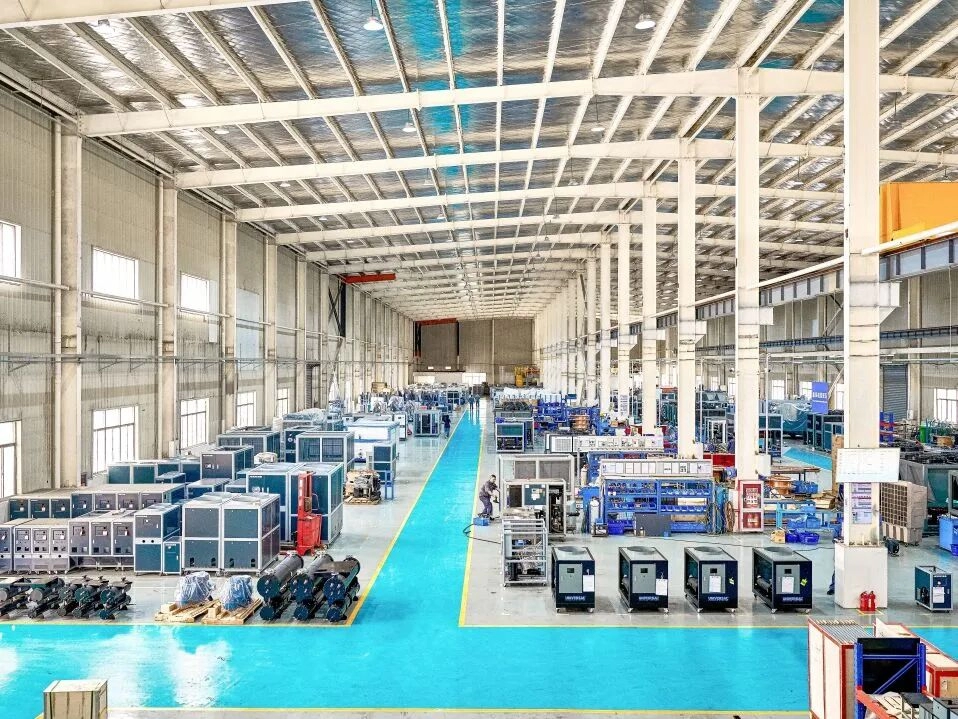
Over the past two decades, AODE has built extensive experience in industrial thermal management equipment manufacturing and system integration.
Founded in Shenzhen in 2004, AODE established Suzhou AODE High-end Equipment Co., Ltd. in Suzhou in 2007. The company has continuously focused on industrial temperature control technology, integrating research and development, production, and sales.
After twenty-two years of innovation and technical accumulation, AODE has evolved from manufacturing traditional mold temperature controllers and water chillers into a provider of integrated industrial temperature control systems and high-end precision temperature control equipment.
Today, SUZHOU AODE PRECISE EQUIPMENT Co., LTD. supports a wide range of industries, including:
· Injection molding
· Die casting
· Chemical processing
· Pharmaceutical manufacturing
· New energy battery production
· Semiconductor processing
· Food manufacturing
· Rubber and composite materials
AODE emphasizes practical engineering performance, system stability, and long-term operational reliability rather than relying solely on theoretical specifications.
Engineers evaluating new systems should consider several critical factors beyond basic heating and cooling capacity.
Different industries require different precision levels. Semiconductor and pharmaceutical applications often require much tighter tolerance control than general manufacturing.
Fast response helps maintain production consistency during load changes or process transitions.
Stable long-term operation reduces downtime and maintenance frequency.
Modern production environments change frequently. Systems should support future integration and capacity upgrades.
Strong technical documentation, accessible manuals, and responsive after-sales support are essential for minimizing operational disruptions.
Industrial temperature control is moving toward greater automation, higher precision, and deeper integration with smart manufacturing systems.
Future developments will likely include:
· AI-assisted temperature optimization
· Predictive maintenance analytics
· More energy-efficient thermal systems
· Integrated IoT monitoring
· Fully automated process adaptation
As production standards continue to rise, the importance of detailed technical documentation and reliable system design will only increase.
For engineers, understanding how to properly interpret and apply industrial temperature control manuals is becoming an increasingly valuable operational skill.