Lithium Cell Cooling Systems: Ensuring Safety and Performance in Modern Battery Manufacturing
View More

 Home News Industry News Integrated Thermal Management Systems: How AODE Builds Smart and Energy-Efficient Factories
In modern manufacturing, temperature stability is no longer a supporting function—it is a core production variable. From precision electronics and automotive components to medical devices and packaging lines, thermal control directly affects product quality, equipment lifespan, and energy consumption. As factories evolve toward digitalization and energy optimization, the demand for integrated thermal management systems is accelerating.
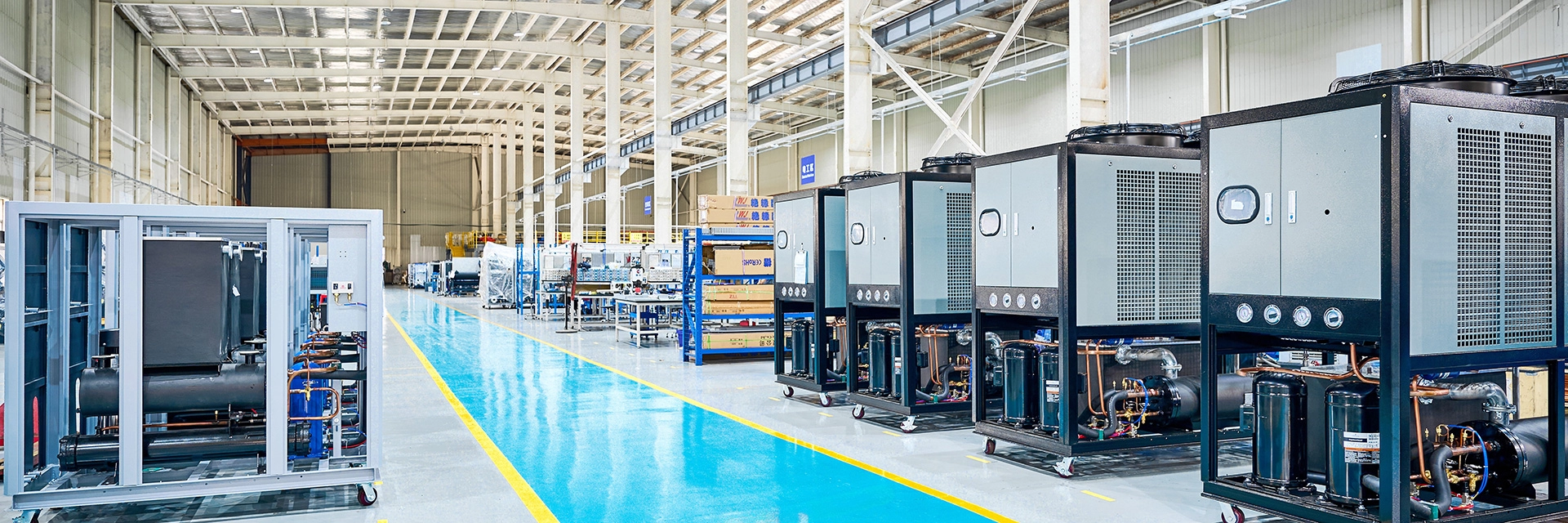
AODE, the brand of SUZHOU AODE PRECISE EQUIPMENT Co., LTD., has been deeply rooted in this transformation. Founded in Shenzhen in 2004 and expanded with the establishment of its Suzhou high-end equipment manufacturing base in 2007, AODE has focused exclusively on industrial temperature control for over two decades. What began as the production of mold temperature controllers and water chillers has evolved into a complete system integration capability covering high-end precision temperature control equipment and large-scale industrial thermal management solutions.
This article explores how AODE builds smart and energy-efficient factories through system-level thinking rather than single-machine delivery.
In traditional manufacturing plants, thermal control equipment is often deployed independently: a chiller for one machine, a mold temperature controller for another, and separate cooling towers or pumps managed manually. While functional, this fragmented model leads to:
Energy waste due to load mismatch
Temperature fluctuations caused by poor coordination
Limited data visibility
Higher maintenance complexity
Modern factories require more than isolated devices. They require integrated thermal management systems that coordinate cooling, heating, fluid circulation, and monitoring across the entire production line.
AODE’s transformation reflects this industry shift. Over 22 years of innovation and engineering accumulation, the company has moved beyond individual equipment manufacturing to become a complete cooling solution provider, delivering turnkey industrial temperature control solutions tailored to each production scenario.
An integrated system is not simply multiple machines connected by pipes. It is a unified architecture combining:
1. Centralized chillers or multi-stage cooling units
2. Precision mold temperature control units
3. Heat exchange modules
4. Intelligent pump stations
5. Flow monitoring and pressure regulation
6. PLC or industrial IoT-based control platforms
AODE’s integrated thermal management systems are designed to manage both temperature and fluid dynamics simultaneously, forming a comprehensive industrial temperature & flow control framework.
This dual focus is critical. Temperature stability depends not only on cooling capacity but also on stable flow rate, pressure balance, and rapid response to load changes. By synchronizing thermal and hydraulic parameters, AODE ensures:
±0.1°C precision control in high-end applications
Stable flow distribution across multi-cavity molds
Fast recovery time during production fluctuations
Reduced mechanical stress on pumps and compressors
AODE’s system approach is grounded in real industrial use cases rather than generic product combinations.
High-speed injection molding requires precise mold temperature control to ensure part consistency and reduce cycle time. An integrated solution may include:
Central water chillers
Multi-loop mold temperature controllers
Automatic water distribution manifolds
Real-time flow monitoring
Instead of assigning a separate chiller to each machine, AODE designs centralized cooling plants with dynamic load management. The system adjusts output according to real-time demand, preventing overcooling and unnecessary energy consumption.
Precision cooling is essential in electronics production, where even minor thermal drift can impact yield. AODE integrates:
High-precision chillers
Closed-loop deionized water systems
Redundant pump configurations
Digital alarm systems
This integrated structure ensures process continuity and stable operating temperatures, which directly enhances yield rate and reliability.
Battery modules, motor controllers, and testing equipment require accurate thermal management across varying loads. AODE designs modular industrial thermal management solutions that can scale with factory expansion, enabling:
Parallel unit operation
Automatic standby switching
Energy-efficient night-mode operation
Data integration with factory MES systems
Energy optimization in industrial environments is rarely achieved by hardware alone. Intelligent control logic plays a decisive role.
AODE incorporates advanced PLC systems and industrial communication protocols to create data-driven thermal control environments. Core features include:
Real-time temperature and flow visualization
Remote monitoring capability
Predictive maintenance alerts
Automatic load balancing
By analyzing operational data, factories can identify inefficiencies such as:
Oversized cooling capacity
Excessive pump head pressure
Poor heat exchanger performance
These insights allow for continuous optimization without interrupting production.
For facilities aiming to implement top industrial temperature control systems, integration with building management systems (BMS) or energy monitoring platforms is increasingly common. AODE’s open communication architecture ensures compatibility with mainstream industrial automation frameworks.
Energy efficiency is often misunderstood as simply lowering power consumption. In industrial environments, aggressive energy-saving measures can lead to instability or shortened equipment lifespan.
AODE’s approach balances efficiency with durability through:
Variable frequency drives for compressors and pumps
Intelligent staging control for multi-compressor chillers
Optimized heat exchanger surface area design
High-efficiency insulation and structural design
Instead of relying on oversized machines operating intermittently, AODE engineers systems that run at optimal load ranges for longer durations. This reduces peak current demand and extends mechanical life.
In centralized cooling systems, dynamic load distribution ensures that no single unit operates under extreme stress, improving reliability across the entire plant.
Becoming a complete cooling solution provider requires long-term service capability. AODE’s integrated delivery model includes:
Pre-project thermal load calculation
System layout optimization
Energy simulation analysis
On-site commissioning
Operator training
Preventive maintenance planning
Many factories struggle not with equipment selection but with system coordination. Improper pipe sizing, unbalanced manifolds, and insufficient redundancy often create hidden performance issues.
AODE addresses these challenges at the design stage, ensuring that hydraulic layout, pipe diameter, and pump configuration are engineered as a unified system.
Smart factory transformation requires measurable improvements. Through integrated industrial temperature control solutions, manufacturers typically achieve:
Reduced energy consumption per production unit
Lower defect rates due to temperature instability
Shorter production cycle times
Improved equipment uptime
Simplified maintenance management
Rather than replacing equipment frequently, factories benefit from scalable architectures. Additional production lines can be connected to existing cooling infrastructure without complete redesign.
This scalability is particularly valuable for fast-growing industries such as automotive electrification, medical equipment manufacturing, and high-end packaging.
The evolution of AODE reflects steady technical accumulation rather than rapid diversification. Since its founding in Shenzhen in 2004 and the establishment of its Suzhou high-end equipment manufacturing facility in 2007, the company has remained focused exclusively on industrial temperature control.
Over 22 years of development, AODE has built capabilities in:
Independent R&D of precision temperature controllers
Industrial chiller manufacturing
System integration engineering
Custom non-standard equipment design
By maintaining control over both manufacturing and system engineering, AODE ensures consistency between design intent and equipment performance.
The company’s transition from mold thermostat and water chiller production to integrated thermal management systems marks its alignment with global industrial upgrading trends.
As industries move toward carbon reduction goals and digital production models, thermal systems will become more interconnected with overall plant intelligence.
Future industrial thermal management solutions will emphasize:
Data transparency
AI-assisted predictive maintenance
Hybrid cooling technologies
Waste heat recovery integration
Cross-plant energy sharing
Manufacturers that adopt integrated architectures today are better positioned to upgrade tomorrow without structural overhauls.
AODE continues to refine its engineering methodologies, focusing on practical, measurable outcomes rather than theoretical optimization. By combining precision equipment manufacturing with system-level integration capability, AODE supports factories in achieving stable production, lower energy intensity, and smarter operational management.
Integrated thermal control is no longer a background utility. It is a strategic infrastructure element in modern industry. Through disciplined engineering, application-specific design, and long-term service commitment, AODE helps manufacturers build smarter, more energy-efficient factories.