Why Precision Optics Temperature Control is the Backbone of High-End Lens Manufacturing
View More

 Home News Industry News Standard Water Temperature Control Units vs Customized Systems: Which One Fits Your Factory?
In modern manufacturing, temperature stability directly affects product quality, production efficiency, and equipment reliability. Whether in plastics processing, die casting, chemical production, electronics manufacturing, rubber molding, or pharmaceutical industries, maintaining accurate and stable thermal conditions has become a core part of industrial operations.
For many factories, the decision often comes down to two options: choosing a standard water temperature control unit or investing in a customized temperature control solution tailored to a specific production process. While standard systems are widely used because of their practicality and shorter delivery cycles, customized systems provide higher flexibility and better compatibility for complex industrial applications.
Understanding the differences between these two approaches can help manufacturers select the most suitable thermal management solution for their actual operating conditions.
Industrial equipment generates heat continuously during operation. If this heat cannot be controlled effectively, it may lead to:
· Product dimensional instability
· Surface defects
· Longer cycle times
· Material waste
· Equipment wear
· Production interruptions
A reliable water temperature controller helps maintain process consistency by regulating the circulating water temperature precisely. In injection molding, for example, stable mold temperature improves product appearance and reduces deformation. In chemical processing, temperature stability ensures accurate reaction conditions. In electronics manufacturing, precise cooling protects sensitive components from overheating.
As manufacturing standards continue to rise, companies are increasingly demanding not only cooling or heating capability, but also intelligent, efficient, and process-oriented temperature management.
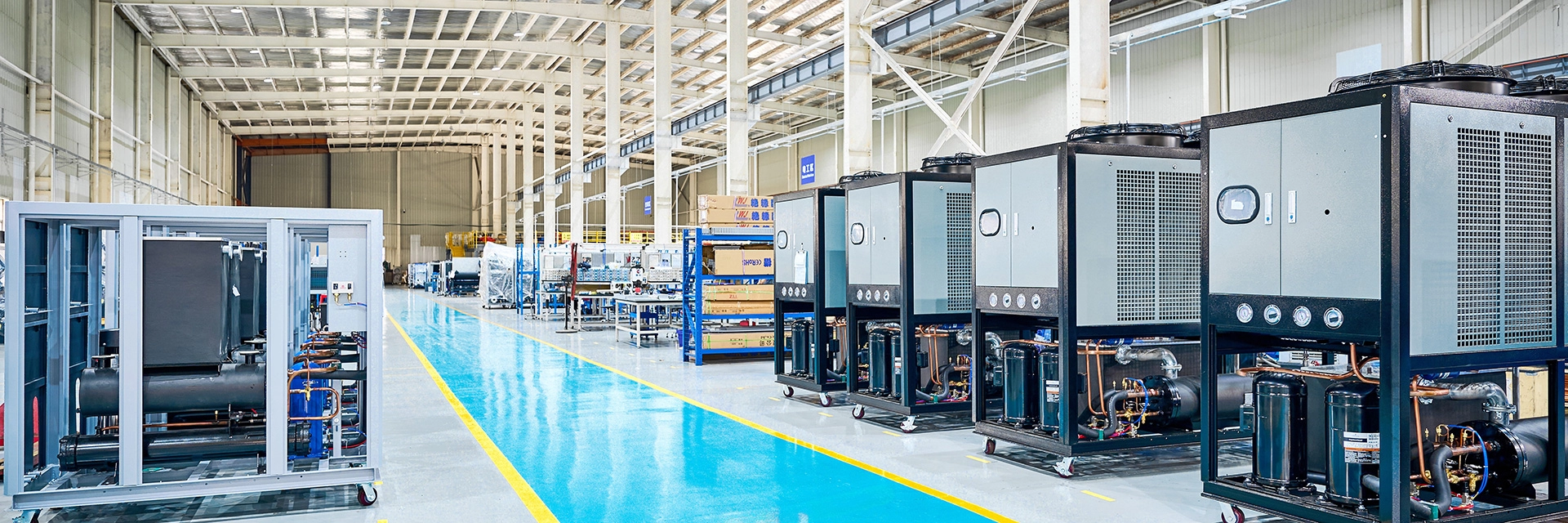
A standard water temperature control unit is a pre-designed and standardized thermal control system manufactured for general industrial applications. These systems typically include:
· Heating components
· Water circulation pumps
· Temperature sensors
· Controllers
· Safety protection systems
· Water tanks and piping structures
Because the configuration is standardized, these units are suitable for industries with common production requirements and relatively stable operating conditions.
A standard water temperature control unit usually offers:
· Fixed heating capacity ranges
· Conventional pump specifications
· Standard piping layouts
· Basic control functions
· Quick installation
· Simplified maintenance
For many factories, especially small and medium-sized manufacturers, standard systems can meet daily production requirements efficiently.
Since standard equipment is already designed and tested, production cycles are shorter. Factories can deploy the equipment quickly and reduce downtime during installation.
Standardized products are often validated through repeated industrial applications. This makes them reliable for routine manufacturing processes.
Spare parts, operation manuals, and maintenance procedures are usually standardized, making after-sales service and troubleshooting more convenient.
Industries with stable process temperatures and standard equipment layouts can often operate efficiently using standard water temperature control units.
However, standard systems are not ideal for every application.
Factories with special production environments may encounter issues such as:
· Insufficient heating or cooling capacity
· Incompatible pipeline layouts
· Difficulty integrating with automated production lines
· Limited communication protocols
· Poor adaptability to future expansion
As manufacturing processes become more specialized, many companies discover that standardized equipment cannot fully optimize production efficiency.
A customized water temperature control system is specifically engineered according to a factory’s process requirements, equipment structure, production capacity, and environmental conditions.
Instead of selecting a fixed configuration, manufacturers can tailor:
· Heating power
· Pump pressure and flow
· Temperature range
· Control logic
· Communication interfaces
· Tank capacity
· Pipeline design
· Energy-saving functions
· Remote monitoring capabilities
This approach allows the thermal system to align closely with actual production demands.
Customized systems are especially valuable in industries with high precision or complex production processes.
In optical products, semiconductor components, medical devices, and high-end electronics, even small temperature fluctuations may affect product quality.
A precision temperature control system provides tighter temperature stability and more accurate process control.
Factories using automated production lines often require centralized thermal management systems capable of communicating with PLCs, MES systems, or intelligent factory platforms.
A customized water temperature control device can integrate seamlessly with automation infrastructure.
Some factories run different production lines simultaneously, each requiring different temperatures and flow rates. Customized systems can support multi-zone independent temperature control.
Certain industrial environments involve:
· High ambient temperatures
· Corrosive liquids
· Long-distance circulation
· Cleanroom requirements
· Explosion-proof standards
Standard equipment may not be sufficient under these conditions.
A standard water temperature machine is built for general use. A customized system is designed around the actual production process.
Factories with rapidly changing production requirements usually benefit more from customization.
Standard systems typically provide stable temperature regulation for ordinary industrial applications. However, industries requiring highly accurate thermal management often rely on customized precision temperature control system solutions.
Customized systems can incorporate advanced energy-saving technologies such as:
· Variable frequency drives
· Intelligent load adjustment
· Heat recovery systems
· Zoned temperature control
These functions help optimize energy consumption during long-term operation.
As factories expand production capacity, customized systems are easier to upgrade and integrate into future equipment expansions.
Standard systems are easier to deploy because the design already exists. Customized systems require more engineering analysis, technical communication, and process evaluation during the planning stage.
Choosing between standard and customized systems depends on several key factors.
If your process temperatures remain stable and your production requirements are relatively conventional, a standard system may be sufficient.
However, if production involves strict thermal tolerances or specialized materials, a customized solution may improve long-term operational stability.
Factories often overlook compatibility issues when selecting thermal equipment.
Before purchasing a water temp controller, manufacturers should consider:
· Existing pipeline structures
· Equipment interfaces
· Pump pressure requirements
· Factory space limitations
· Automation system compatibility
Customized systems can solve integration challenges more effectively.
While standard systems may offer faster deployment, poorly matched equipment can increase:
· Energy consumption
· Product defects
· Downtime
· Maintenance frequency
A properly designed water temperature control system can improve production efficiency and reduce long-term operational losses.
Factories planning future automation or production upgrades should prioritize scalable system architecture.
Customized systems usually provide better flexibility for future process changes.
Industrial manufacturing is rapidly moving toward smart factory operations. Modern thermal systems are no longer simple heating or cooling devices.
Today’s advanced water temperature control units increasingly include:
· Touchscreen HMI interfaces
· IoT remote monitoring
· Real-time data collection
· Intelligent alarms
· Predictive maintenance
· Centralized control platforms
These technologies improve operational visibility and help manufacturers reduce unplanned downtime.
As industries pursue higher precision and lower energy consumption, demand for intelligent customized systems continues to grow.
Founded in Shenzhen in 2004, AODE established SUZHOU AODE PRECISE EQUIPMENT Co., LTD. in Suzhou in 2007. Over the past twenty-two years, AODE has focused on industrial temperature control technology, integrating research and development, manufacturing, sales, and system engineering capabilities.
From its early development of mold temperature controllers and chillers, AODE has gradually expanded into complete industrial temperature control integration and high-end precision thermal management equipment.
Today, AODE provides both standard and customized thermal control solutions for various industries, including:
· Injection molding
· Die casting
· Rubber processing
· Chemical production
· Optical manufacturing
· New energy industries
· Electronics manufacturing
By combining engineering experience with practical industrial applications, AODE helps manufacturers improve temperature stability, energy efficiency, and production consistency.
For factories with conventional production needs, standardized systems offer reliable and efficient operation. For complex industrial environments, customized solutions provide more precise control and stronger system adaptability.
There is no universal answer when choosing between a standard water temperature control unit and a customized thermal management system. The right solution depends on production requirements, process complexity, equipment compatibility, and long-term operational goals.
Standard systems are practical, reliable, and efficient for common industrial applications. Customized systems offer greater flexibility, higher precision, and stronger scalability for specialized manufacturing environments.
As industrial production continues evolving toward automation, intelligence, and higher precision, selecting the right temperature control partner becomes increasingly important.
A professional thermal control supplier not only provides equipment, but also helps manufacturers optimize production performance, improve product quality, and build a more stable manufacturing system for future growth.