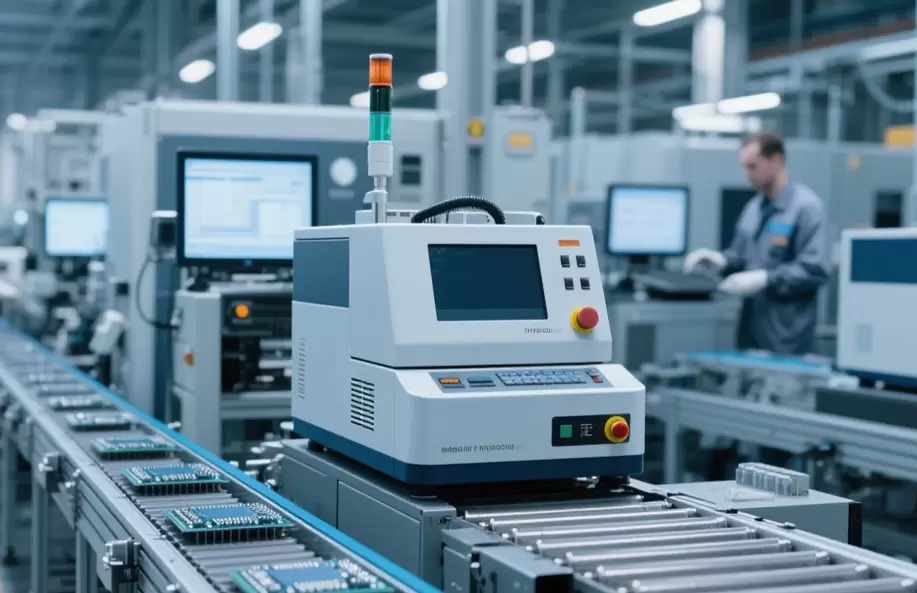
Precision Cooling for Electronics: How AODE Enhances Product Reliability and Yield Rates
View More

 Home News Industry News Integrated Cooling Solutions for Rubber Production: AODE Advances Industrial Temperature Control Technology
Rubber manufacturing is one of the most temperature-sensitive industrial processes. Whether producing automotive seals, conveyor belts, industrial hoses, rubber sheets, or precision molded components, maintaining accurate process temperatures directly affects product quality, production efficiency, material consistency, and equipment reliability. As manufacturing standards continue to rise, companies are increasingly looking for integrated temperature management systems instead of isolated cooling equipment.
A modern cooling solution for rubber production is no longer limited to lowering temperatures after processing. Instead, it combines heating, cooling, circulation, monitoring, and intelligent control into one complete system that supports every production stage. With more than two decades of experience in industrial temperature control, AODE continues to help manufacturers optimize rubber and polymer production through reliable, customized, and energy-efficient temperature control technologies.
Founded in Shenzhen in 2004 and establishing Suzhou AODE High-end Equipment Co., Ltd. in 2007, AODE has focused exclusively on industrial temperature control. After twenty-two years of continuous innovation, the company has grown from manufacturing mold temperature controllers and water chillers into a professional enterprise integrating research, development, manufacturing, sales, and complete industrial temperature control system solutions.
Rubber compounds undergo multiple thermal processes before becoming finished products. During mixing, extrusion, calendaring, vulcanization, and cooling, even small temperature fluctuations can influence material behavior.
Poor temperature control may lead to:
· Uneven vulcanization
· Surface defects
· Dimensional instability
· Internal stress
· Reduced mechanical properties
· Increased scrap rates
· Longer production cycles
Different rubber formulations—including natural rubber, EPDM, NBR, silicone, fluororubber, and thermoplastic elastomers—each require carefully controlled processing temperatures. Manufacturers therefore need flexible systems capable of maintaining stable thermal conditions throughout production.
An integrated temperature control system allows every production stage to remain within its optimal operating window, improving both product consistency and production efficiency.
Today's rubber manufacturers face several operational challenges beyond simply controlling temperatures.
Automotive, aerospace, electronics, and medical industries demand tighter dimensional tolerances and more consistent material properties than ever before.
Faster extrusion and molding cycles generate more process heat, requiring cooling systems with higher efficiency and faster response times.
Factories seek to reduce energy consumption while maintaining productivity, making intelligent temperature management increasingly important.
Large manufacturing plants often operate several production lines simultaneously, each requiring different temperature settings and independent control.
These challenges have driven demand for custom industrial temperature control solutions that can adapt to complex manufacturing environments.
An integrated cooling system combines several technologies into one coordinated platform rather than relying on individual standalone machines.
Typical components include:
· Industrial chillers
· Mold temperature controllers
· Heat exchangers
· Circulating pumps
· Precision temperature sensors
· PLC automation systems
· Intelligent monitoring software
· Water or thermal oil circulation systems
Instead of treating heating and cooling as separate operations, these systems continuously regulate process temperatures throughout production.
For example, during extrusion, the compound may require heating before entering the die while downstream cooling stabilizes product dimensions. An integrated system coordinates both stages automatically.
AODE has developed comprehensive industrial temperature control technologies covering temperatures from sub-zero cooling to high-temperature heating applications.
Its product portfolio includes:
· Industrial water chillers
· Mold temperature control units
· Oil temperature control systems
· High-temperature water temperature units
· Industrial thermal oil heaters
· Precision cooling systems
· Centralized temperature control systems
· Customized thermal management solutions
By integrating mechanical engineering, automation, fluid control, and thermal engineering, AODE delivers reliable solutions for demanding manufacturing environments.
Each system is designed according to customer-specific production processes rather than offering a one-size-fits-all approach.
Internal mixers generate significant frictional heat.
Without effective cooling, excessive temperatures can:
· Damage polymer chains
· Accelerate premature vulcanization
· Reduce compound consistency
Industrial cooling systems maintain stable mixing temperatures, ensuring repeatable compound quality.
Rubber extrusion requires precise cooling immediately after material exits the die.
Proper cooling helps achieve:
· Stable dimensions
· Smooth surfaces
· Reduced deformation
· Faster production speeds
Depending on product requirements, manufacturers may use water cooling, air cooling, or combined cooling technologies.
Compression molding, transfer molding, and injection molding all depend on accurate mold temperatures.
A stable temperature control unit provides:
· Uniform mold heating
· Controlled cooling cycles
· Shorter cycle times
· Improved curing consistency
· Longer mold life
Maintaining uniform mold temperatures reduces thermal stress while improving product repeatability.
Rubber curing requires extremely stable thermal conditions.
Temperature fluctuations may result in:
· Under-curing
· Over-curing
· Reduced tensile strength
· Poor elasticity
· Shortened product lifespan
Intelligent temperature control systems continuously monitor and adjust heating throughout the vulcanization process.
After curing, products must cool evenly to prevent deformation.
Controlled cooling minimizes:
· Warping
· Internal stress
· Dimensional changes
· Surface defects
Integrated cooling equipment ensures stable product quality before inspection and packaging.
Modern industrial cooling systems increasingly incorporate intelligent control technologies.
Advanced PLC-based systems can automatically:
· Monitor process temperatures
· Adjust cooling capacity
· Control pump operation
· Record production data
· Trigger alarms
· Optimize energy consumption
Operators receive real-time process information while reducing manual intervention.
For manufacturers operating multiple production lines, centralized monitoring simplifies equipment management and maintenance planning.
Many manufacturers produce both rubber and plastic products within the same facility.
AODE's thermal management expertise also extends to various polymer processing applications.
For example, plastic manufacturing cooling requires accurate thermal control during injection molding, extrusion, thermoforming, and blow molding.
Similarly, plastic plate cooling is essential for maintaining dimensional stability and preventing internal stress during sheet production.
In film production, plastic film cooling directly influences transparency, flatness, thickness uniformity, and winding quality.
An efficient industrial cooling solution for plastic processing enables manufacturers to increase production speeds while maintaining consistent product quality across different polymer materials.
By applying common thermal engineering principles, AODE develops integrated solutions that support both rubber and plastic manufacturing operations.
Every production process has unique thermal requirements.
AODE engineers customize systems based on:
· Material characteristics
· Production capacity
· Ambient conditions
· Factory layout
· Process sequence
· Automation requirements
· Future expansion plans
Industries served include:
· Automotive components
· Tire manufacturing
· Industrial rubber products
· Plastic processing
· Chemical manufacturing
· Composite materials
· Electronics
· Packaging
· Medical products
· Energy equipment
Rather than selecting standard equipment alone, manufacturers benefit from integrated engineering that considers the entire production workflow.
Customized system integration offers several important benefits.
Stable temperatures produce more consistent physical properties and better dimensional accuracy.
Optimized heating and cooling shorten production cycles while increasing equipment utilization.
Variable-capacity cooling and intelligent controls reduce unnecessary energy use.
Proper thermal management protects machinery from overheating and extends equipment lifespan.
Integrated system design simplifies maintenance and improves operational reliability.
These advantages help manufacturers improve competitiveness while supporting long-term production stability.
Choosing temperature control equipment involves much more than selecting a chiller or heater.
An experienced supplier should understand:
· Production processes
· Material behavior
· Heat transfer engineering
· Automation integration
· Energy optimization
· Long-term equipment maintenance
Manufacturers should evaluate suppliers based on:
· Engineering capability
· Industry experience
· Customization ability
· Product reliability
· Technical support
· Manufacturing quality
· After-sales service
A long-term technology partner can help optimize production as manufacturing requirements evolve.
For more than twenty-two years, AODE has remained dedicated to industrial temperature control technology.
Its strengths include:
· Extensive R&D experience
· Comprehensive temperature control product portfolio
· Custom engineering capabilities
· Integrated system solutions
· Advanced manufacturing facilities
· Strict quality management
· Responsive technical support
Rather than supplying individual machines alone, AODE works closely with customers to develop complete thermal management systems tailored to specific production processes.
Whether the application involves rubber vulcanization, polymer extrusion, precision molding, or complex industrial manufacturing, AODE provides dependable solutions that improve process stability, product quality, and operational efficiency.
As rubber and polymer manufacturing become increasingly sophisticated, temperature control has evolved from a supporting function into a core production technology. Stable thermal conditions influence every stage of production, from raw material preparation to final product cooling, directly impacting quality, efficiency, and operating costs.
Integrated temperature control systems provide manufacturers with a smarter approach by combining heating, cooling, circulation, automation, and monitoring into one coordinated platform. This holistic strategy reduces process variation, enhances productivity, and supports sustainable manufacturing.
Backed by over twenty-two years of expertise, SUZHOU AODE PRECISE EQUIPMENT Co., LTD. continues to advance industrial temperature control technology through innovative engineering, customized system integration, and reliable equipment designed for demanding industrial applications. As manufacturers pursue higher precision and greater efficiency, AODE remains committed to delivering comprehensive thermal management solutions that help customers achieve stable, efficient, and future-ready production.